Sleep guidance that learns your baby — not a chart
Compass learns from your baby's own sleep and gently suggests what's likely to work for them.
Why generic schedules so often don't fit
Most baby sleep advice online is a fixed, age-based schedule: nap here, feed there, lights out at seven. Most apps are reassuringly precise. The trouble is, it was written for an average baby — and no one is raising an average baby.
So you follow the schedule, the nap doesn't work out, and you're left fighting a baby who was never going to sleep at that moment — quietly wondering what you're doing wrong.
The schedule didn't fail because you got it wrong. It failed because it was never about your baby in the first place.
Every baby is different — really
Temperament, nap quality, appetite, a developmental leap, even how the day has gone — all of it shifts what your baby needs from one day to the next. Two babies born the same week can need wake windows 45 minutes apart and both be completely healthy.
Our wake window calculator shows the typical ranges by age, and they're a genuinely useful starting point. But "typical" can only ever get you to the right neighbourhood — not to your baby's front door. For that, you need to watch your baby, over time. Which is exactly how Compass supports you.
How Compass learns your baby
You log, with a tap
Each sleep and feed goes in super simple. No essays, no faff — just a quick record of how the day actually went.
Compass studies the pattern
Quietly, it records their sleep signals, how their naps land, and how their day tends to flow — building a picture of your baby specifically.
It suggests what's likely to work
Instead of a one-size schedule, you get nap and wake-window suggestions shaped by your baby's real data — a steer for the day ahead, not a rule to obey.
It keeps adjusting
As your baby grows, goes through leaps, drops a nap, your patterns change — and Compass moves with them, so the guidance stays current.
Honest about timing: Newborn sleep can be a little all over the place during this phase and iltimately very hard to predict. Compass needs a little logged sleep before its suggestions are meaningful too, so personalised predictions start to unlock from around 13 weeks (corrected age). In the early weeks it helps you log, ask questions and find your feet.
Tuned to the day, sharpened over time
Compass works on two timescales — and it's honest about both.
It adjusts the wake-window guidance to the day in front of you — when your baby last woke, ther overnight sleep, the type of naps they've had — so it fits today rather than an average.
Its read on your baby's tired cues is built from a rolling 30-day average — so the cue guidance sharpens the longer you log, settling into what's normal for your baby.
Either way, it stays a suggestion — something to weigh against your baby's tired cues and your own instinct, never a rule that overrides them.
What a guided day can look like
Here's an illustrative day for a 6-month-old following Compass-style windows. Yours will look different — that's rather the point.
Compass, on your phone
A calm, uncluttered view of your baby's day — and a gentle hand when things get tough.
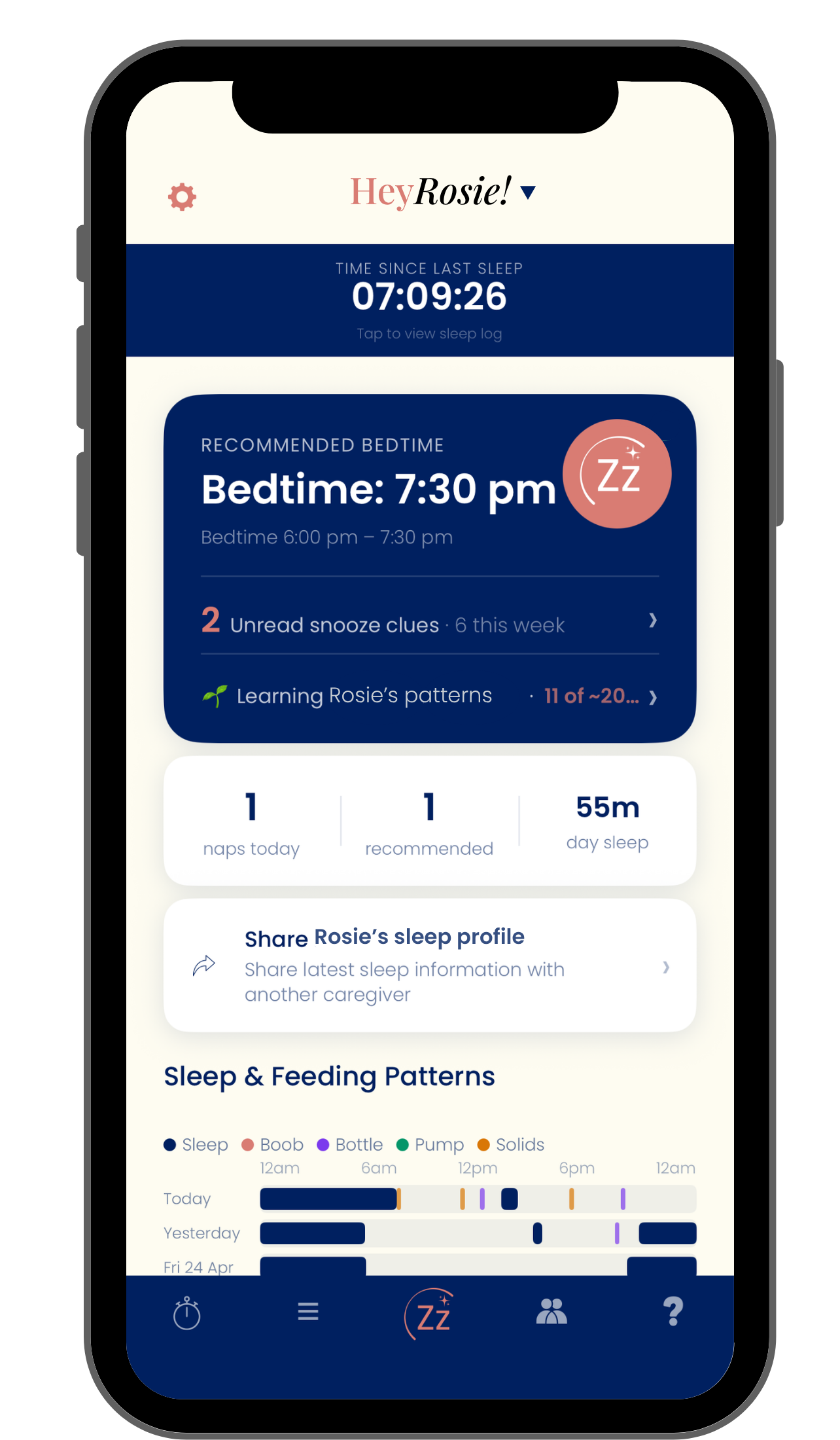
Predicted naps, a shareable profile and your baby's daily rhythm — sleep and feeds together

Your baby's sleep profile — the tired signs to watch for

Gentle guidance for when things start to feel tough
Stop guessing. Start noticing.
Download HeyBaby, log a few sleeps, and let Compass start learning your baby. Free to start — Compass is part of Premium at £5.99/month, cancel anytime.
Free to start · Premium £5.99/month · Cancel anytime
Compass FAQs
How does HeyBaby Compass work?
Compass learns from the sleep you log in HeyBaby — when your baby wakes, how the naps land, how the day flows — and uses that to suggest personalised nap and wake windows shaped by your baby's real patterns rather than a generic age chart. It's guidance to weigh against your baby's cues, not a fixed rule.
When does Compass start predicting naps?
Compass needs a little logged sleep before its suggestions are meaningful and newborn sleep is notoriously unpredictable, so personalised predictions unlock from around 13 weeks (corrected age). Before then it helps you log and find your feet, leaning on typical ranges for your baby's age.